
National Technology Day
Fast Facts
- WHAT
- Recognizes and celebrates how technology has impacted our lives
- WHEN
- Celebrated each year on January 6
- FOUNDER
- Founded by AXEL® in 2016
- VIBE
- Catalytic, Empowering, Trailblazing
NATIONAL TECHNOLOGY DAY
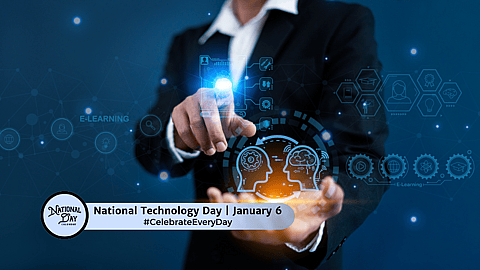
National Technology Day on January 6th recognizes how technology changes the world and looks to the future of technology. Each year, from the wheel to smartphones, the day honors technological achievements that impact our daily lives.
#TechnologyDay
Imagine a world without technology. In our modern daily lives, it is nearly impossible to take a step without encountering some form of digital or mechanical innovation. Far from being confined to screens and computers, technology is found in virtually every sector of the global economy.
Tech roles consistently rank among the strongest and fastest-growing employment divisions. In fact, being tech savvy is a basic requirement in nearly every career path.
6 Career Paths that use Technology
-
Agriculture: Precision farming, satellite imaging, soil sensors, and automated harvesting systems optimize crop yields while conserving water and labor.
-
Healthcare: Electronic health records, artificial intelligence accelerates drug discovery, robotic surgical suites enhance precision, and remote telemetry monitors patient vitals in real time.
-
Education: Adaptive learning platforms tailor curriculums to individual student paces, while virtual collaboration tools dismantle geographic barriers to quality instruction.
-
Entertainment: Sophisticated rendering engines, spatial audio, and recommendation algorithms curate, produce, and deliver interactive media at global scale.
-
Food Service: Predictive inventory management, automated kitchen robotics, and seamless point-of-sale systems reduce food waste and speed up delivery logistics.
-
Security & Infrastructure: Machine learning algorithms detect cyber threats before breaches occur, while smart surveillance and biometric verification protect physical assets.
Technology does more than keep us organized and connected--it serves as a base for successful employment. It sharpens our productivity, automates routine labor, safeguards public health, and generates data-driven insights into how our world functions.
Apps
Apps (short for applications) represent one of the most dynamic fronts of modern technology, reshaping how we live, work, and interact. What started as simple smartphone novelties of pixelated games and basic photo filters, app technology has evolved into the backbone of our daily digital routines. They help us manage our personal finances, monitor vital health metrics, give us the ability to work remotely, and give us control of our homes while on vacation. What has evolved from novelty conveniences are now indispensable tools for daily living.
Communication
One of the most successful areas of technology is communication. The various tools available to help us communicate with people in real time are found at work, on social media, and through messaging apps. Consider all the ways we convey a message in today's world.
Evolution of Communication
Cave Paintings & Early Symbols
Early humans began recording stories, hunting records, and ritual practices visually on rock walls. Sites like Chauvet and Lascaux represent humanity's earliest surviving external information storage.
Invention of Written Language
The Sumerians developed cuneiform in Mesopotamia, while ancient Egyptians developed hieroglyphs. Writing severed human communication from the limits of immediate memory, allowing laws, trade inventories, and history to outlive the speaker.
Phoenician Alphabet
Phoenician traders established a standardized, phonetically based alphabet of 22 consonants. Unlike thousands of complex logograms or ideograms, a simple phonetic system made literacy accessible to common merchants and travelers, later inspiring the Greek and Latin alphabets.
Invention of Paper
Cai Lun formalized the papermaking process in Han Dynasty China using mulberry bark, hemp, rags, and fishnet. Paper provided a far lighter, more portable, and cheaper medium for written records than stone, bamboo strips, clay tablets, or animal parchment.
Movable-Type Printing Press
Johannes Gutenberg perfected the movable metal-type printing press in Mainz, Germany. Mass reproduction of text collapsed the cost of books, democratized literacy across Europe, and accelerated both the scientific revolution and religious reformations.
Electrical Telegraph
Samuel Morse, Alfred Vail, and William Fothergill Cooke developed long-distance electric telegraph systems. In 1844, Morse transmitted the first formal intercity message ("What hath God wrought?") between Washington, D.C. and Baltimore, separating communication speed from the physical limits of horse or rail transport for the first time.
Telephone
Alexander Graham Bell patented the acoustic telephone, transmitting real-time human voice across electrical wires. It enabled instant, bidirectional personal dialogue across long distances without requiring specialized cipher knowledge like Morse code.
Wireless Radio Transmission
Guglielmo Marconi demonstrated long-distance wireless radio wave telegraphy, completing a transatlantic transmission in 1901. Radio soon transitioned into public broadcasting in the 1920s, enabling one speaker to address millions of households simultaneously.
Television & Mass Video Broadcast
Philo Farnsworth created the first fully electronic television system, followed by the first regularly scheduled live public broadcasts in the 1930s. Synchronized sound and moving image brought cultural, political, and documentary events directly into the private living room.
ARPANET & E-Mail
The U.S. Department of Defense launched ARPANET, introducing packet-switching networks.
In 1971, computer engineer Ray Tomlinson implemented the first network email system using the @ symbol to direct messages between individual machines.
The World Wide Web (www)
Tim Berners-Lee authored HTTP, HTML, and URL standards at CERN to create the World Wide Web. Released to the public domain in 1993 alongside early graphic browsers like Mosaic, it transformed the internet from an academic network into an open, global information repository.
Mobile Phones & SMS
The first short message service (SMS) text message ("Merry Christmas") was sent over the Vodafone GSM network in December 1992. By the late 1990s, widespread adoption of compact mobile phones untethered personal communication from stationary landline hardware.
Smartphone & Social Media
The mid-2000s saw the rapid rise of social networks (e.g., Facebook in 2004) followed by the 2007 debut of the iPhone. This pairing combined telecommunications, internet browsing, cameras, and direct broadcast capabilities into a single pocket device carried continuously by billions of people worldwide.
CELEBRATING NATIONAL TECHNOLOGY DAY
Explore the ways technology impacts your life. Every day, it continues to change the way we live and drive us further into the world of the future. Ways to celebrate include:
-
Explore technologies of the past. Which ones would you bring back if you could?
-
Share your favorite technologies with others and explain why you like the technology.
-
Discuss how technology has impacted your life with friends and family. Ask one of the elders in your family if they enjoy technology or find it difficult.
-
Test out new technology or share your ideas for a new technology. You might be able to make your idea a reality!
-
Start a discussion about technology on social media using the hashtag #TechnologyDay.
NATIONAL TECHNOLOGY DAY HISTORY
AXEL®, a technology-based company, headquartered out of Las Vegas, founded National Technology Day. The Registrar at National Day Calendar declared National Technology Day in 2016.
Media Contacts
AXEL®: Dmitry Kogosov | 702.948.9770
Technology FAQ
How long has technology been around?
Technology is older than the harnessing of fire. Anything that advances productivity is technology, including tools, medicines, techniques, and more.
Is technology for everyone?
Yes. With so many different kinds of technology, everyone uses, accesses, and even relies upon technology. Even those who live "off the grid" access technology of some sort. While some of the technology may be thousands of years old, those tools have become a survival necessity.
What technological age are we in?
The digital age began in the 1980s and continues today.
Shop this day
What's Next